Your algorithm is lying to you. Love hurts. Try it.
Writing by: Bethany Cummings [@blndegirl]
![Sex[Ed.]'s avatar](https://substackcdn.com/image/fetch/$s_!GL8o!,w_108,h_108,c_fill,f_webp,q_auto:good,fl_progressive:steep/https%3A%2F%2Fsubstack-post-media.s3.amazonaws.com%2Fpublic%2Fimages%2F828bff3a-291f-4a3c-bb73-8b389745ca01_644x644.png)
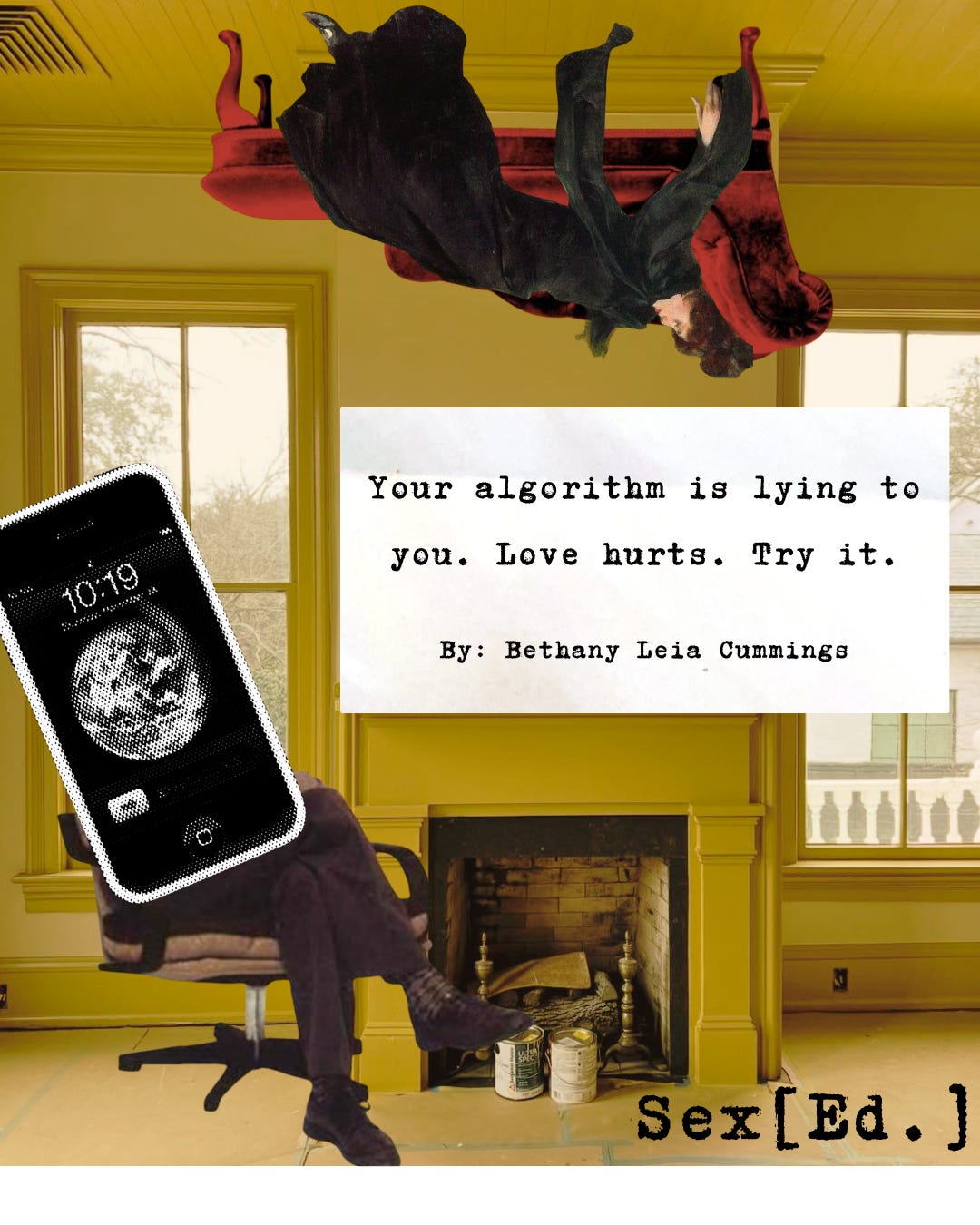
We’ve pathologized love, forgetting it isn’t something to diagnose, or to optimize, but to experience; heartbreak and all.
“Is it love or is it limerence?”
“10 signs you may be an avoidant.”
“How to manifest the partner of your dreams.”
“You’re only attracted to them because they resemble patterns from your childhood.”
How about… you’re only human!!
Maybe this is a me problem, and my algorithm just knows I’ve found myself in my own “situationship”, but it seems like we’ve become obsessed with diagnosing and pathologizing one of the most natural occurrences of life: love. And honestly, I’m growing tired.
With a quick search as to what a “situationship” is, it turns out there is an Oxford definition that describes it as a romantic or sexual relationship that is not considered formal or established. https://www.oxfordlearnersdictionaries.com/definition/english/situationship
The Cambridge dictionary gave a similar definition, calling it a romantic relationship between two people who do not yet consider themselves a couple but who have more than a friendship.
https://dictionary.cambridge.org/dictionary/english/situationship
Then I went to TikTok. And in going through the videos, I actually giggled at how many charts with several stages and examples, and powerpoints explaining what it is and what it isn’t. And on top of all that, though the consensus tends to lie with dictionary definitions, the meaning of this term, or the place of situationships in the dating scene, seems to be ambiguous, even controversial. Am I making my point about the exhausting part yet?
The other day, my friend asked me if her going to movies with a guy she’s already been seeing for a couple of months was considered “dates”. And I ended up giving her a long-winded answer about we’ve lost mutual agreement on what things mean. How with the rise of individualism and digital communication, things are interpreted in isolation, weakening shared communal frameworks. She told me I was being too philosophical with it and laughed, which is probably true.
Language changes and supports our meanings of concepts and experiences. And now, we have new words being added to the dictionary at a faster rate because of how fast things are picked up online. The caveat: being on a different side of the internet might change your whole perspective on it.
The most frustrating part of the speed at which new terms travel is watching it happen with clinical terms. Narcissism, gaslighting, love bombing, toxicity, boundaries…. the list goes on. Misuse or overuse of these terms, however, is not new, at least not completely. The psychology literature is constantly critiquing and changing diagnosis standards. Psychopathology, or diagnosis, is often considered when symptoms or dispositions interfere with everyday life. However, it has been of recent concern that we are attaching clinical terms to typical emotional experiences or perfectly normal responses to the stress of our societal systems. This is a critique of both popular culture and therapy.
Now, let me just situate myself here for a minute. I am a psych student, and it is honestly practically my whole life; it is who I am, and I love that. But in this, I have been able to be more vigilant towards the dangers of this micro-pathologizing, weaponized therapy talk, and the monstrosity that is the dissemination of scientific research to social media. Just think of how many times you’ve seen someone diagnose another in a comment section.
I think it’s great that there has been a newfound appreciation and intrigue toward the world of psychology from the mainstream. But with these questions and quizzes of attachment styles, rules like no contact, and new terms like situationship, let’s remember we are not all experts, and that is ok. The field of psychology itself is constantly criticizing the diagnostic manual and the psychopathologies included. For example, homosexuality was listed as a sociopathic personality disturbance in the diagnostic standard manual (DSM) until 1974, when it was replaced with “sexual orientation disturbance,” which pathologized individuals for being distressed about their sexuality. This stayed in place until 1980. You cannot be expected to follow the “rules” of psychology, because there is no such thing. Psychology is a relatively new science that is constantly evolving and is about deepening understanding, not creating laws to abide by.
I am here to tell you, you can relax. That you don’t need to kill yourself trying to go no contact, and that just because you meet the criteria in one TikTok about avoidant attachment, you are not doomed. And you still deserve love. And that maybe… just maybe…You don’t need to leave your situationship.
It’s no secret that humans love to label everything. And with the snowballing nature of social media, we can do it a lot more now, with more labels. And this can be a good thing, giving a name to a feeling, allowing for healing to begin, finding a community alike, and being able to enact in self-research. But have we taken it too far? Has it become limiting? From amateurs diagnosing to my attachment style to my TikTok psychic telling me the love of my life is just right around the corner… It’s a lot.
Personally, I’ve found it has filled me with fear, made me feel inadequate, and challenged me in being able to form my own opinion in my own love life. If I were to follow all of these so-called rules on how to do relationships right, from amateurs to professionals, I would never have any relationships. I know I have things to work on, albeit my attachment style. Maybe I’ve chosen the wrong guy at times because it was all too familiar, but I wouldn’t take it back. Why wouldn’t I gravitate toward the love I recognize? It’s discerning the love we deserve and should stay for that’s the tricky part.
I mean, seriously, ask yourself: Are we thinking too highly of ourselves to think we can dodge one of the inevitable parts of life, heartbreak? We’ve been given all these answers as if they are some guide to avoid pain, but hasn’t anyone told you? Love hurts.
Nonetheless, these notions are still very much rooted in something real. I wouldn’t be doing my psych background justice if I did not address this. In my opinion, becoming more accepting of psychopathologies and finding parts of them within ourselves should make us realize these patterns can be found within every single one of us.
The problem lies with the fact that the stigma of pathology is very much still rampant and causing real harm. So now we have people diagnosing themselves and strangers around them, resulting in people thinking they’re screwed, because those on a more extreme scale in today’s society are kind of screwed.
The danger is that it can result in a self-fulfilling feedback loop. Where people behave in ways they think others with the same label or psychopathology do. And social media gives us an overwhelming number of ways to do this. The need to be the extreme, or the archetype, to be valid in our experience. Then we’re left with everyone having an identity crisis, searching for the line that tells us what’s wrong so real healing can begin.
I think it’s important to note, however, that relationships and the language used around them to infuse their meaning, and language, period, for that matter, have always been evolving. We can hate on “situationships,” but in reality, romantic relationship dynamics have changed in response to culture, politics, and religion throughout history.
So let’s consider our modern climate. How, at younger ages, we’ve become increasingly aware of the corruption in our world, we witness wide-scale travesties represented on phone screens, we see that the world is quite literally on fire, and we likely won’t be able to afford our own home. It is no wonder we have all become nihilists who are terrified of commitment; we can’t even see hope in our own future. The notion of marriage that we’ve inherited was never neutral. It was developed as an economic and legal arrangement to uphold a patriarchal social order. As women gain more autonomy, and non-heteronormative couples become more visible, it is no wonder that the institution itself, and our understandings of love within it, are being called into question.
I mean, sure, being courted and going to balls sounds lovely, but I’d take my situationship over my father signing over my life to another man just to sleep in different ends of the home any day. (I don’t know if that’s accurate or something I saw in Bridgerton, but don’t come for me, I’m not a history major.)
Let me say this again because I really need it to sink in… YOU ARE ONLY HUMAN. It is natural to seek patterns familiar to childhood; it is natural to be scared of someone leaving you if you were actually once abandoned. And I’m gonna hold your hand when I say this, you will only be able to learn to cope with these issues, and explore these parts of yourself, by leaning into them… with someone else!! That doesn’t mean don’t hold yourself accountable when these issues come up, it just means, to allow feelings as they come, stop overanalyzing, stop listening to strangers about intimate parts of your life, and try listening to your heart.
I’ve come to realize recently that if our ego, the one doing all the observing and thinking about the self, becomes too consuming, then there will simply be no room for the heart and soul. And that’s where the good shit comes from. Not just thinking and analyzing, but experiencing. I feel very passionate about this being true, but I may be the one who needs to hear it most. So I leave us with this mantra…I allow myself to devourrrr. ;)